Diesel vs. Petrol Fuel: Which Is Best For Your Campervan Holiday?
You’ve chosen your road trip buddies, created the perfect playlist and started planning all the places you want to visit. Just before you hit the open road, there’s one more thing to consider: should you rent a petrol or diesel campervan?
It might not be the most exciting part of planning a holiday (we know you much rather look up beaches and campsites), but choosing the right fuel type could make a difference to your travel budget, especially if you’re planning to explore everything Australia has to offer.
Petrol and diesel campervans each have their advantages, and knowing the difference could help you make a more budget-friendly choice before setting off on your next adventure.
What’s The Difference Between Petrol and Diesel?
For a quick reference, our 2-Berth and 4-Berth Hi-Tops run on petrol, while the 2-Berth Tamar, 4-Berth Henty and 6-Berth Derwent use diesel. Both petrol and diesel vehicles will get you from point A to point B, but they work a little differently.
Petrol engines are generally smoother and quieter, making them a familiar choice for campervan and motorhome travellers who are used to driving regular cars on the daily. They’re great for shorter journeys with plenty of pit stops along the way. On the other hand, diesel engines are known for their fuel efficiency and ability to produce more torque even at lower engine speeds. In simple terms, they’re better at going uphill, carrying more weight, and can be economical when travelling longer distances.
Diesel isn’t automatically the best option. The size and weight of the campervan, driving conditions and the ever-changing fuel prices all play a part in how much you’ll end up spending.

Image: The best engine is the one that suits your holiday plans
Calculating Your Estimated Fuel Expenses
To get a rough idea of your fuel expenses, check the campervan’s estimated fuel consumption, usually measured in litres per 100 kilometres (L/100km). The lower the number, the less fuel the vehicle is expected to use over that distance.
The Tamar has an estimated fuel consumption of 11L/100km, while the rest of the GoCheap campervan range sits at around 14L/100km. This means that the Tamar would need approximately 110 litres of fuel for a 1,000km journey.
For example, if diesel costs $2.80 per litre today, you’d be looking at around $308 in fuel for the whole 1,000km trip. It’s a simple calculation that can help you set aside a realistic fuel budget before you leave, rather than finding yourself constantly transferring money into your travel account halfway through the holiday.
Important Note: Fuel consumption figures are estimates based on vehicle specifications. Actual consumption may vary depending on driving conditions, load and driving habits. The price of diesel and petrol changes daily, so the figure mentioned above may not be accurate at the time of reading this article.
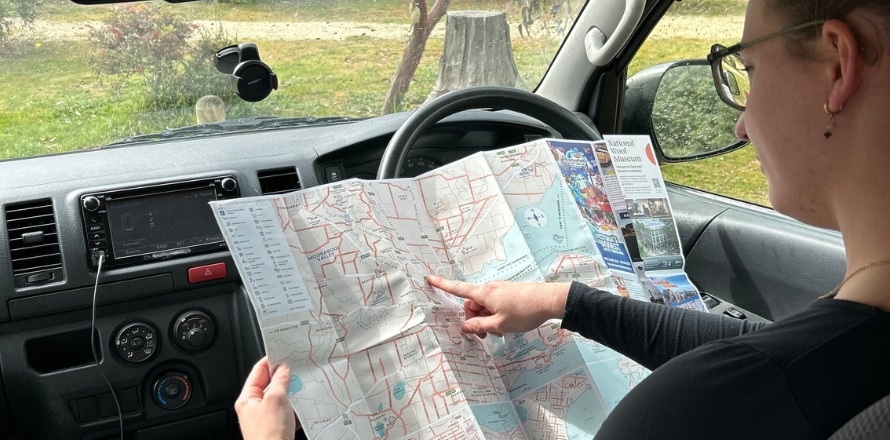
Image: Mapping your road trip route can save you fuel in the long run
Choosing A Campervan For Your Travel Route
One thing you’ll quickly learn about road tripping around Australia is that everything seems a lot closer on Google Maps, so where you’re going can help you lock in which campervan to choose.
City and Urban Getaways
If your itinerary involves exploring cities, checking out local cafés and spending afternoons at the beach, a petrol campervan could be a suitable option. Petrol engines are generally more comfortable for city driving where you’re frequently stopping at traffic lights or navigating busy streets. They also can be a great match for shorter holidays, offering a practical and convenient way to explore nearby attractions at your own pace.

Image: Smaller campervans work better for city driving, especially when trying to find parking!
Long Distance Adventures
If you’re planning to cover hundreds of kilometres over several days, a diesel campervan is worth considering. Diesel engines are generally well suited to long stretches of highway driving, where they can operate efficiently at steady speeds. Their higher torque at lower engine speeds also makes them useful for heavier motorhomes, particularly when climbing hills or travelling with a full load of passengers and luggage.

Image: Windy roads are a breeze with stronger torque
Fuel Stops in Regional Australia
Australia is a massive country, and the distance between servos can be much greater than you’d expect, especially in regional and remote areas. Fuel prices also tend to be higher outside major cities, so planning your fuel stops ahead of time could save you from an expensive fill-up.
Before heading off, check your campervan’s estimated fuel range and make sure you’ve got enough for the journey and use the PetrolPulse website to plan your fuel stops based on your route. The last thing you want is to be running low on fuel with the next servo another hundred kilometres away!

Image: Don’t wait for the fuel warning light to turn on when driving in regional Australia
Top Tips To Save Fuel On Your Holiday
- Travel light: The less weight you carry, the less work your engine has to do, which can help improve fuel efficiency! Read our packing guide for more tips.
- Plan your route: Avoid unnecessary detours and backtracking by grouping nearby attractions together.
- Check fuel prices: Compare fuel prices at nearby servos using apps like FuelCheck (NSW and TAS), Servo Saver (VIC), FuelWatch (WA) or Petrol Spy (nationwide) rather than driving around to different stations, using up your fuel even more.
- Maintain a steady speed: Constant speeding up and slowing down can increase fuel consumption, so drive smoothly and stick to the speed limit.
Most importantly, always double-check the fuel type before filling up! Putting petrol into a diesel campervan (or vice versa) can cause massive engine damage and turn your dream road trip into an expensive headache.
So, Petrol or Diesel?
There’s no clear winner when it comes to choosing between a petrol and diesel campervan. Both have their advantages, and the right choice depends on your travel plans.
Petrol campervans can be a practical option for shorter journeys, particularly if you’re looking for a smaller vehicle that’s comfortable to drive around cities and coastal towns. Diesel campervans are worth considering for longer journeys or when travelling in a larger motorhome, thanks to their generally better fuel efficiency and pulling power.
That said, fuel type shouldn’t be the only thing influencing your decision. Consider how much space you’ll need, the facilities included in the campervan and how much driving you’ll be doing. A petrol campervan is still perfectly capable of handling a long road trip, so it’s worth comparing the fuel consumption of the vehicles you’re considering rather than choosing diesel simply because you’re planning to drive more.

Image: No matter which vehicle you choose, you can still have an amazing trip around Australia
Ready To Start Planning Your Campervan Trip?
A little research before booking can save you from choosing a vehicle that doesn’t quite suit your holiday, even if it looks like the cheaper option on paper.
Our reservations team is here to help if you need assistance in choosing the perfect campervan. Give us a call at 1300 664 485 (+61362484789 for international callers) or send us an email at reservations@gocheapcampervans.com.au.
We have a bunch of resources, including itineraries, available on our website. You can find some holiday park recommendations in our travel blog, and check the amenities that are included in the campervans that are available. Check out our website to see the campervans we have available at our branches!
Share your adventures with us using the #GoFurtherGoCheap hashtag on social media 💚